


How to Wash Muslin Fabric Without Damaging It
Muslin is a soft, lightweight cotton fabric, and one of the reasons people like it is the way it becomes softer and more comfortable with use. But because muslin is often made with a relatively open construction, washing it the wrong way can affect its size, shape, texture or color.
The good news is that muslin does not require complicated care. In most cases, a gentle wash, moderate temperature and careful drying are enough to keep it in good condition.
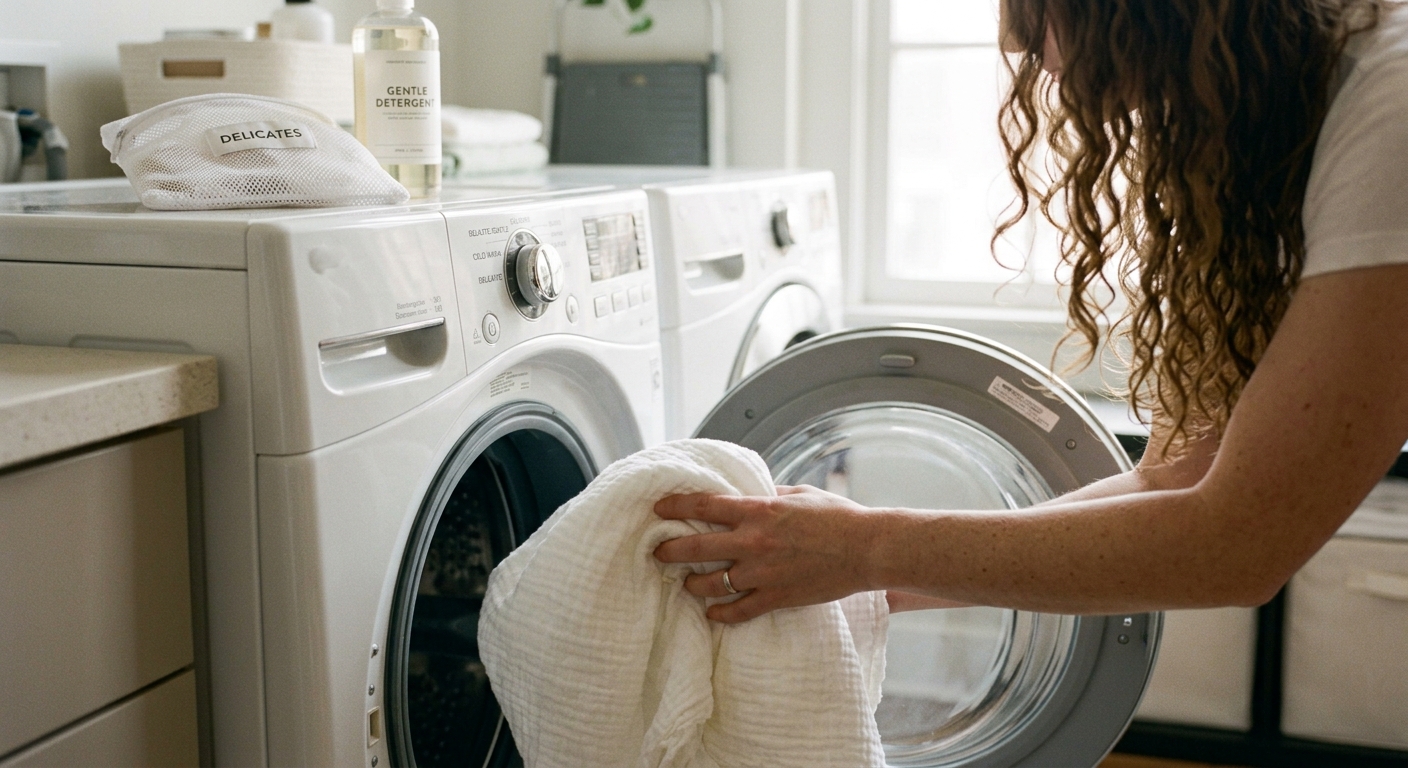
Can Muslin Fabric Be Washed in a Washing Machine?
Yes. Cotton muslin can generally be machine washed, but the safest approach is to use a gentle cycle and avoid unnecessarily high temperatures.
The exact care requirements can vary depending on the fabric construction, dye, print and finishing. A printed muslin fabric may need more attention to color than an unprinted white fabric, while a delicate 1-layer fabric may need gentler handling than a heavier 4-layer construction.
If the manufacturer has provided specific care instructions, those should always take priority.
For finished products such as clothing, bedding or blankets, it is also worth checking the care label before washing. The fabric itself may be washable, while other parts of the finished product, such as trims, embroidery or elastic, may have different requirements.
What Temperature Should You Use to Wash Muslin?
For everyday washing, cool or lukewarm water is usually a safer choice than very hot water.
Cotton can change dimension when it is washed and dried. Shrinkage is affected not only by the cotton fiber itself, but also by the fabric’s construction and the stresses introduced during manufacturing and finishing. Cotton Incorporated’s CottonWorks explains that fabric construction, wet processing, finishing and laundering all influence dimensional change.
This is particularly relevant to muslin because its open construction can make dimensional changes more noticeable.
A high-temperature wash is therefore not something muslin needs in order to get clean. For normal household washing, a moderate temperature is usually enough and places less stress on the fabric.
Should You Wash Muslin Separately?
For a new colored or printed muslin fabric, washing it separately the first time is a sensible precaution.
Some dyes can release a small amount of color during washing. Colorfastness depends on the dye, the fabric and the production process, and unsuitable laundry products or poor rinsing can contribute to color loss or staining.
This is especially worth considering with strongly colored fabrics or printed designs. Once you know how a particular fabric behaves, it can be washed together with similar colors.
White muslin and pale-colored muslin are generally easier to combine with other light-colored cotton textiles.
What Detergent Is Best for Muslin?
A normal mild laundry detergent is generally sufficient for muslin. There is no need for an especially strong detergent simply because the fabric is cotton.
Using too much detergent does not make a fabric cleaner. Excess detergent can be harder to rinse completely and may leave unwanted residue on the fabric.
For printed muslin, a gentler detergent is a good choice because repeated washing can gradually affect the appearance of printed and dyed fabrics. Washing and drying involve mechanical action and can contribute to changes in color and surface appearance over time.
Bleach should not be used unless the care instructions specifically allow it. Chlorine bleach in particular can affect dyes and can weaken some textiles.
Should Muslin Be Washed Inside Out?
Turning a finished garment or other printed product inside out before washing can reduce direct rubbing against the printed surface.
This is not essential for every muslin product, but it can be useful for printed clothing, children’s textiles and other products where maintaining the appearance of the design is important.
For fabric sold by the meter, this obviously is not practical or necessary. The important point is to avoid excessive mechanical action when the fabric is being washed.
Does Muslin Shrink When Washed?
It can. The amount of shrinkage depends on the particular fabric and how it was manufactured and finished.
Shrinkage is not simply a matter of cotton “getting smaller” when it becomes wet. During weaving and finishing, yarns and fabric can be held under tension. Washing and drying allow some of these stresses to relax, which can result in dimensional change. CottonWorks describes shrinkage as a change in fabric or garment dimensions caused by relaxation and changes in the fabric’s environment.
Heat and mechanical action during drying can also contribute to dimensional change. This is one reason that a hot wash followed by a hot tumble-dry is more likely to produce noticeable shrinkage than a gentle wash followed by air drying.
If you are going to use muslin to make clothing, bedding or another item where the final dimensions matter, prewashing the fabric before cutting can be a sensible precaution. It allows the fabric to undergo much of its initial dimensional change before you make the finished product.
Choosing Quality Muslin Fabric From Selonya
If you are looking for muslin fabric by the meter, the quality of the fabric matters just as much as how you care for it. A well-made muslin fabric can offer the softness, breathability and durability needed for clothing, bedding and other everyday textile products.
Selonya, a brand owned by Celik Tekstil, is one of the trusted names in the Turkish textile industry and is closely associated with 100% cotton fabrics. Its muslin collection is made from 100% cotton, offering a natural, breathable and comfortable fabric suitable for a wide range of applications.
Selonya muslin is produced with a focus on superb quality, durability and breathability. It is also OEKO-TEX® Standard 100 certified, meaning the fabric has been tested according to the requirements of the standard for harmful substances.
For manufacturers, designers and customers looking for reliable cotton muslin fabric, choosing a fabric from an established textile brand can provide additional confidence in both quality and consistency. Whether you need lightweight muslin for clothing, soft fabric for baby and children’s products, or a more substantial multi-layer construction for blankets and home textiles, Selonya 100% cotton muslin is designed to combine everyday comfort with dependable quality.
You can explore the available Selonya muslin fabric collection to see the different colors, layers and options available.
Does 1-Layer Muslin Need Different Care From 4-Layer Muslin?
The basic washing principles are similar, but the fabrics can behave differently because their constructions are different.
1-layer muslin is very light and has less material in the fabric. It can be more easily affected by rough mechanical handling, especially when wet.
2-layer muslin has more body and can generally tolerate normal gentle washing well.
4-layer muslin contains considerably more material, so it may hold more water and take longer to dry. The fabric itself is not necessarily more difficult to wash, but the additional thickness can make drying more important.
In all three cases, excessive heat and aggressive mechanical action are best avoided.
How Should Muslin Be Dried?
Drying is just as important as washing when it comes to protecting muslin.
Air drying is usually the gentlest option. After washing, remove the fabric without excessive twisting or wringing and allow it to dry naturally.
For clothing, you can reshape the garment while it is still damp. This helps reduce unwanted distortion and makes ironing easier later.
For larger pieces such as bedding or blankets, make sure the fabric is properly supported while drying. Very wet cotton becomes heavier, and hanging a large wet textile from one small point can put unnecessary stress on the fabric.
Tumble drying can be used when the product’s care instructions permit it, but high heat and strong mechanical action can increase the risk of shrinkage. CottonWorks notes that drying method and mechanical action affect fabric consolidation and dimensional change.
If preserving the original dimensions is particularly important, air drying is the safer choice.
Can You Tumble Dry Muslin?
It depends on the particular muslin product and its care instructions.
If tumble drying is permitted, using a low or moderate heat setting is preferable to a high-temperature cycle. Remove the fabric when it is dry rather than leaving it in the dryer for an unnecessarily long period.
The reason is not simply that “heat makes cotton shrink.” Drying shrinkage is related to changes in the fiber, yarn and fabric structure, while mechanical action in the dryer can also encourage the fabric to consolidate.
For this reason, gentle tumble drying is quite different from repeatedly washing and drying muslin on a hot, aggressive cycle.
How Do You Keep Muslin From Getting Too Wrinkled?
Muslin naturally wrinkles more than fabrics designed for a smooth, pressed appearance. This is part of the character of a lightweight cotton fabric.
You can reduce wrinkles by taking the fabric out of the washing machine promptly and reshaping it while it is damp. Hanging or laying it properly while drying can also help.
If the fabric still needs ironing, it is usually easier to iron it while it is slightly damp rather than completely dry.
There is no need to try to make muslin perfectly flat. A slightly relaxed, natural appearance is normal for this type of cotton fabric.
Can You Iron Muslin After Washing?
Yes. Muslin can generally be ironed, but a moderate temperature is preferable to excessive heat.
If the fabric is dry and difficult to press, a little moisture or steam can make the process easier. Always be more careful with printed fabrics, since direct high heat on a printed surface can affect its appearance.
For a printed muslin garment, turning it inside out before ironing can provide additional protection for the printed side.
The iron should keep moving rather than remaining in one place for a long time.
How Should Printed Muslin Be Washed?
Printed muslin deserves a little extra care because there are two things to protect: the cotton fabric and the printed design.
A cool or moderate-temperature wash, mild detergent and gentle mechanical action are good starting points. Turning finished products inside out can reduce rubbing against the printed surface.
It is also better to avoid unnecessarily frequent washing. Washing is not harmless to textiles; abrasion during laundering can gradually change surface appearance, while repeated washing can affect color and other appearance properties.
This does not mean that printed muslin is difficult to care for. It simply means that normal, gentle washing is preferable to aggressive washing.
What About Stains on Muslin?
Fresh stains are usually easier to remove than old ones, so treating a stain before the next full wash can help.
Avoid immediately scrubbing the fabric hard. Muslin is relatively light, and aggressive rubbing can damage the surface or make the affected area look different from the surrounding fabric.
Instead, gently work an appropriate stain treatment into the affected area and then wash according to the fabric’s care instructions.
For printed muslin, test a cleaning product on an inconspicuous area first if you are unsure how the print will react.
Should You Prewash Muslin Before Sewing?
If you are buying muslin by the meter and plan to turn it into a finished product, prewashing is often a good idea.
The reason is simple: you want the fabric to undergo its initial washing-related dimensional change before you cut your pattern.
This is especially important for clothing and fitted home textiles. If the fabric is cut and sewn first and then shrinks noticeably during the first wash, the finished product may no longer have the dimensions you intended.
Cotton fabric can have residual shrinkage resulting from its construction and processing, and manufacturers use different finishing methods to control it.
The exact amount of shrinkage cannot be assumed from the word “muslin” alone. If precise dimensions are important, the best approach is to check the supplier’s specifications or test a sample before cutting a larger quantity.
What Is the Safest Way to Wash Muslin?
For most cotton muslin products, the safest routine is quite simple: use a gentle wash with cool or moderate-temperature water, use a mild detergent, avoid unnecessary bleach and aggressive mechanical action, and let the fabric air dry when possible.
The most important thing is not to treat every muslin fabric as though it has exactly the same properties. 1-layer, 2-layer and 4-layer fabrics can have different constructions, and printed and plain fabrics can also have different care requirements.
If you are working with fabric by the meter, prewashing before cutting can help account for dimensional changes. If you are caring for a finished product, the manufacturer’s care label should take priority.
Conclusion
Muslin is not difficult to wash. In fact, one of the advantages of cotton muslin is that it can be used for everyday textiles that need regular washing.
The main things to avoid are excessive heat, aggressive washing and unnecessary mechanical action. These can contribute to shrinkage, color changes and changes in the appearance of the fabric.
A gentle wash followed by careful drying will usually keep muslin soft and in good condition. And if you are making a garment, blanket, bedding or another product from muslin fabric by the meter, washing the fabric before cutting can help you avoid unpleasant surprises later.
For different colors, layers and printed designs, you can explore Selonya’s muslin fabric collection.